


Most people with even the most minimal interest in this historical topic have heard of “Greek Fire.” It was a legendary weapon, sometimes it is even pictured as a super-weapon. It was not quite that, but in certain sets of circumstances it could make a huge impact. It could win battles and even change the course of history such as in the 717-718 siege of Constantinople.
ORIGINS:
In 678, Constantinople was under threat from the rising Arab superpower, the Caliphate. For the fifth year in a row an Arab fleet, terrorized Constantinople. It had been “raised and dispatched by the great Caliph Muawija and based at the captured peninsula of Cyzicus, just south of Constantinople, was combining with an army before the European walls of the city to besiege the Byzantine capital. Seemingly powerless to drive off the newly established naval power of the Arabs, the Byzantines huddled within their walls and prayed.” [Secrecy, Technology, and War: Greek Fire and the Defense of Byzantium, 678-1204 by Alex Roland]
The Romans needed an advantage, and they were gonna get one!
Roman prayers were seemingly responded to thanks to a man by the name of Kallinikos, an inventor who had recently escaped from the fallen Roman province of Syria.
His goal was, allegedly, was “to bring a new and decisive invention to the Byzantines. He had invented what came to be called Greek fire, a napalm-like substance that burned in water and could be projected great distances from the bows of ships. Relying on his weapon, the Byzantines succeeded in driving off the Arab fleet and lifting the siege of Constantinople. The Arabs, for their part, encountered a killer storm in their flight for home and lost most of the remaining vessels that had not been scorched by Kallinikos and his fire.” [Secrecy, Technology, and War: Greek Fire and the Defense of Byzantium, 678-1204 by Alex Roland]
GREEK FIRE – CHANGING THE HISTORY OF THE WORLD:
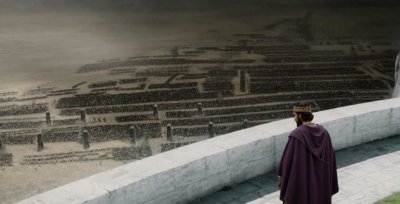
In 717-718 the Roman Emperor Leo III had to face the full might of the Caliphate. I wonder what he felt seeing allegedly 120,000 men and an armada of 1800 ships besieging Constantinople. But he led his people to victory! And Greek fire was a huge part of that!
THE SECRET FORMULA:
A lot of discussion has occurred about what exactly Greek fire or Liquid fire was made of, the formula and composition of the substance itself. But how did the Byzantines manage to keep the weapon’s formula secret?
“The answer seems to be the Coca-Cola technique: mix and bottle the liquid in a central plant where the formula can be controlled and then ship it to distributors. The central plant was somewhere in Constantinople, perhaps at the main arsenal, perhaps at one of the satellite arsenals around the city. The distributors were the outfitters and commanders of the various Byzantine fleets that employed Greek fire. They received the substance sealed up in jars and poured it into their machines as directed. The formula was only part of the secret.” [Secrecy, Technology, and War: Greek Fire and the Defense of Byzantium, 678-1204 by Alex Roland]
THE SECRET DELIVERY SYSTEM:
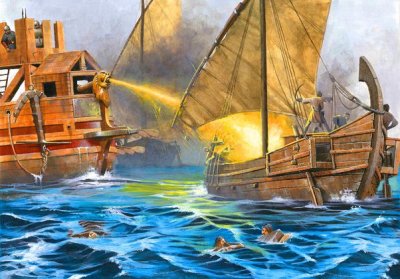
“Understanding how the secret might have been guarded requires some appreciation of the components of the technology. Technology may be defined as purposeful, human manipulation of the material world. It consists of four components: matter, power, a tool or machine, and technique..In the case of Greek fire, the formula provides only the matter. The power, fire, was obvious, but the machine and the technique were not. The caldron in which the liquid was preheated and pressurized was concealed below deck on the dromons, masking both the machinery and the technique for employing it…The technique itself would have been a secret of almost as much sophistication as the formula, as without pressure gauges and safety valves it was surely a delicate task to heat and pressurize a highly volatile liquid in dark and cramped quarters below deck… Remarkably, there seems to be no recorded instance of one of the fire ships blowing itself up.” [Secrecy, Technology, and War: Greek Fire and the Defense of Byzantium, 678-1204 by Alex Roland]
“Thus, even if one of the components of the weapon system came into enemy hands, there was no guarantee it could be used successfully. The Bulgars in 814 captured some 36 siphons and a considerable quantity of the Greek fire, but there is no evidence that they knew what to do with it.” [Secrecy, Technology, and War: Greek Fire and the Defense of Byzantium, 678-1204 by Alex Roland]
This shows that the secret was two-fold, the formula, which was emulated by the Arabs, and the delivery system which was not.
WHAT DID THE SIPHONS LOOK LIKE?
What metal the siphons were made of is not fully understood today, as we do not have an example of a siphon that survived. But we do know some things about it.

“Theophanes the Confessor wrote that the siphones that the Bulgarian Khan Krum captured at Develtos in 812 were made of bronze. Both Leo VI and Nikephoros Ouranos said that they were ‘bound‘ in bronze, and Anna Komnene or her sources said that those which Alexios I had made had mouths in the form of the heads of lions and other animals made of iron or bronze: …, on the prow of each ship he [Alexios I] had fixed the heads of lions and other land animals in bronze or iron, with their mouths open, surrounding them with gold to make the mere appearance terrifying. He prepared the fire that was to be emitted against the enemy to come out through their mouths so that the lions and other animals appeared to be belching out fire.” [The Age of the Dromon]
GREEK FIRE IN USE:
The Roman chronicler Theophanes described the use of Greek fire against the Arab fleet in 717: “With God’s help the pious Emperor immediately sent fireships against them…which turned them into blazing wrecks. Some of them, still burning, smashed into the sea wall, while others sank into the deep men and all, and still others, flaming furiously, went as far off course as the islands Oxeia and Plateia.”

I find the description of burning ships crashing into the sea walls to be a vivid image in my mind. Imagine the fearful inhabitants and soldiers of Constantinople watching the unfolding action from the walls and seeing such a fiery spectacle. Theophanes said: “Because of this, the spirits of the city’s inhabitants were lifted, but their foes shivered in terror, recognizing how strong the liquid fire was. They had planned to anchor at the sea walls to attack the battlements at the narrow neck of land on the same evening. But, at the intercession of his wholly chaste Mother, God shattered their plan.”
For Theophanes and the Romans, only God could explain this wild success. Theophanes also hinted that the Emperor Leo III wanted to set another trap for the Arab fleet when he “mysteriously drew up the chain (across the Golden Horn), but the enemy thought he wanted to entice them and would stretch it out again: they did not dare come in to anchor within the confines of Galata.”
Anna Komnene, author of the Alexiad, a history of her father the great Emperor Alexios Komnenos, recorded a use of Greek fire during the late 11th century against a Pisan fleet: “The Roman fleet drew near and a Peloponnesian count called Perichytas, who specialized in naval ambush, as soon as the enemy came in sight rowed hard and fast in his monoreme against them. He went through the Pisan centre like a flash of lightning and returned to the Romans, who unfortunately did not enter the battle in a disciplined manner – they made sharp, disorderly attacks. Landulf himself was the first to make contact with the enemy, but his fire missed the target and all he did was to squander the fuel. The count called Eleemon boldly made for a very large vessel by the stern, but fouled its rudders and found it hard to disengage. He would have been caught, too, if he had not quickly remembered the fuel prepared for his tubes and scored a direct hit with Greek fire. He then deftly maneuvered his ship in either direction and immediately set light to three very big vessels of the Pisans.”
THE LAST CENTURIES OF GREEK FIRE:
The substance had quite a reputation. When the Crusaders attacked Constantinople in 1204 they seemed to prepare for it to be deployed against them, but they did not. Instead, it seems the technology had been lost.
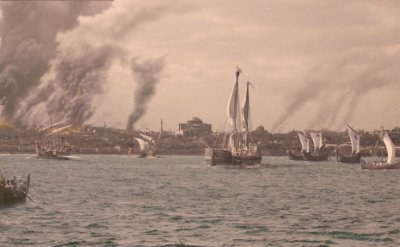
“According to Niketas (Choniates), the Venetians covered their galleys with ox hides as protection against fire, almost as though they expected to have to counter Greek Fire; however, neither he nor any Latin chronicler mentioned it actually being used against them. Some naval resistance was mounted in the Golden Horn by a few Byzantine ‘triereis‘ but these were either destroyed or driven ashore and abandoned. It is striking that whereas in 1043 the remnants of a similarly decayed Byzantine navy had been able to scatter the Rhos attack on Constantinople with Greek Fire, it was apparently not used in 1203. The implication is clear. At Constantinople in 1203 the Byzantine galleys were not equipped with Greek Fire.”

This is shocking, it had clearly been used many times in the preceding centuries. It was exactly the type of weapon which potentially could have prevented the fatal Golden Horn attacks by the Venetian fleet. “After the 10th century, Greek fire and fire-bearing ships continued to be mentioned by various authors; for example, Michael Psellos, who described in classicizing language the remnants of the imperial fleet which scattered the last Rus attack on Constantinople in 1043 as being composed of triereis and fire-carrying ships…and who described their use of Greek Fire, with which the Rus ships were destroyed.”

“John Kinnamos and Niketas Choniates also referred to the continuing use of Greek Fire in the twelfth century. Kinnamos wrote that the Saljuqid sultan Izz al-Dın Qilij Arslan II was treated to a demonstration of it when he visited Constantinople in 1162. Fire ships were prepared against the Normans of Sicily in 1147 and pursued a Venetian ship fleeing Constantinople at the time of the arrest of the Venetians in the Empire in 1171. Liquid fire was also used against the fleet of the rebel strategos Alexios Branas in 1187.”
What actually happened to it is not clear, either access to the materials to produce the substance was lost, or the knowledge itself was lost as the Roman navy deteriorated rapidly after the death of Manuel Komnenos in 1180. The weapon was perfect for the defense of Constantinople, and its absence was felt in 1204.
GREEK FIRE IN 1453?
No, there was no Greek fire in 1453 during the final battle against the Ottomans for Constantinople. In fact in the 15th century John Chortasmenos read old histories such as Niketas Choniates and wondered: “Where is this Greek Fire now?” He must have been quite impressed by its abilities, but already by his time it was the stuff of legend and in text only, not in the real world. [The New Roman Empire: A History of Byzantium by Anthony Kaldellis]
SOURCE:
The Age of the Dromon by John. H Pryor and Elizabeth M. Jeffreys
Secrecy, Technology, and War: Greek Fire and the Defense of Byzantium, 678-1204 by Alex Roland
The Chronicle of Theophanes, translated by Harry Turtledove.
The Alexiad, translated by E.R.A Sewter
The New Roman Empire: A History of Byzantium by Anthony Kaldellis
 shadowsofconstantinople.com