

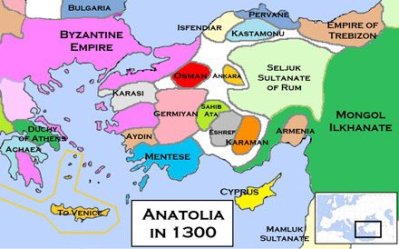
Andronikos II Palaiologos was desperate to save Anatolia, and hired the Catalan Grand Company. “The Catalans performed some remarkable feats of arms against the Turks and showed what could be done in the way of reconquest…” However, the issue was that they were violent, independent, greedy, and uncontrollable by the Emperor.

The Emperor Andronikos II himself “had few contacts with the western world since 1282, but the Venetians and Genoese had spread the word around that the Byzantine Empire was in desperate trouble.” People in the West knew Anatolia was falling apart and that the Roman Empire struggled to field competent armies. Anytime armies were successful, the generals were removed from power. This news reached the Catalan Company, an elite band of mercenaries who were out of work. This suited Andronikos well, who was scared to empower a Roman general whom might overthrow him.
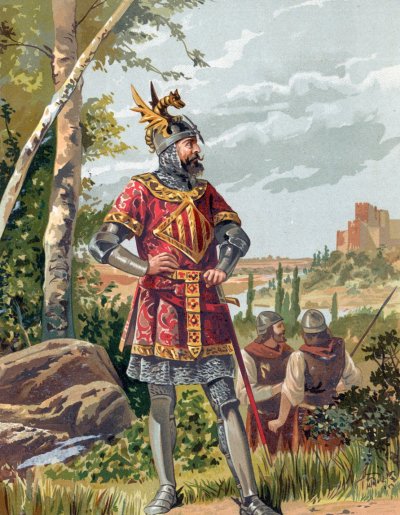
Seeing a lucrative opportunity for him and his soldiers, the Catalan leader Roger de Flor offered his services to Andronikos. However, Roger was a troubled character who had once been a Knights Templar but was kicked out “for embezzlement and misconduct.” Then “he had taken to piracy and formed his own company of knights.”
Despite those red flags, it was a fact that “The Catalan Grand Company, which he now commanded, had a well-earned reputation as fighting men.” The Romans clearly could see their martial prowess. The chronicler Pachymeres wrote they were “men who died hard in battle and were ready to gamble with their lives.”

So of course Andronikos looked at them and thought: Can they defeat the Turks for me? On that basis the Emperor took a gamble, and brought these tough, but dangerous, men into the imperial fold. “Andronikos gave thanks to heaven for what seemed like a miracle and accepted the offer without hesitation.” Perhaps he should have thought about things being too good to be true…
When it came to talk about compensation “Roger was a hard bargainer, but the Emperor gladly agreed to all his conditions. The Catalans were to be paid double the amount normally paid to mercenaries, and for 4 months in advance. Roger was to marry the Emperor’s niece, and to be honored with the title of Grand Duke.” Both sides were showing commitment and enthusiasm for this endeavor.
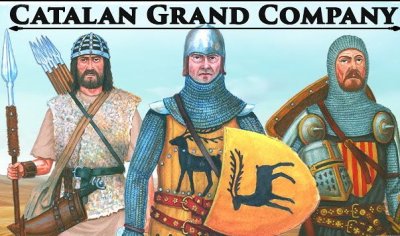
In September 1303 the Catalans arrived in Constantinople, around 6500 warriors & their families. “Andronikos was anxious that the Catalans should leave the capital without too much delay…Within a few days of their arrival they became involved in murderous street fighting.” The signs of trouble were thus immediately clear. But, they were not here to hang around in Constantinople and the Emperor sent them to Anatolia.

The Catalans went to Kyzikos in Anatolia for the winter. But they immediately began plundering the local Romans! This showed that “there was a fatal difference between the Catalan Company and mercenary troops they had employed before.” These mercenaries did not have the oversight of Roman commanders! This means they were more akin to something like the Crusader armies rather than the Roman army.

The Emperor may have made an agreement with Roger and his men, but the Catalans were wise enough to see Andronikos could do little to force his will. “The Emperor, who was their employer, might suggest plans of campaign, but the conduct of those campaigns was in their own hands, and any marginal profits they might take in the way of loot, whether at the expense of Greeks or Turks, were fair gain” in their eyes.
But, they did go and fight the Turks! In early 1304 they got to work and repelled the Turks from Kyzikos. However, their liberation efforts in Anatolia did not feel so helpful to the locals. That is because “they caused so much damage to the city that even Roger de Flor felt bound to pay the inhabitants an indemnity.” Victory was victory though, and they moved on.

Roman distrust of these foreigners was naturally growing, “the Catalans moved on to Pegai, but their reputation had gone before them.” Michael IX, the Emperor’s son, refused them entry to the city. He clearly despised the treatment of the local Romans, and probably saw the threat they posed. The Catalans thus moved onto Philadelphia, which was under siege by the Turks.
In April 1304 they reached Philadelphia, and defeated the Turks in battle. “Roger and his men entered the city in triumph” as liberators! According to Donald M. Nicol “the relief of Philadelphia was the only practical service that the Catalans rendered” to the Romans. He added: “Roger made no attempt to follow up his victory by marching south to the Meander valley,” an important area. “The town of Tripoli had just been taken by the Turks, the towns of Nyssa and Tralles were already in their control. But the Catalans left them to their fate.” This showed that the Catalans were not strictly here to do what was best for their Roman employers.

The Catalans did continue their campaign, though. “Roger led his men west again to Magnesia on the Hermos river and thence down to the coast of Ephesos, where he could make contact with his fleet whose sailors had already occupied the islands of Chios, Lesbos, and Lemnos.”
“The Catalans were later to boast of a long march that they made from Ephesos along the south coast of Asia Minor, driving all before them up to the borders of the kingdom of Armenia.” “The Turks fled from them in terror. But such heroics had no lasting consequences” in Anatolia

While the Catalans were marching in the south, Ephesos, which they had just liberated, was retaken by the Turks in October 1304. Roger was furious! He began punishing Roman officers, priests, officials, and soldiers for “indiscipline or dereliction of duty wherever he found them.” Even priests were punished!

One major problem concerning Constantinople was that Roger realized he could do what he wanted. The reality was that Andronikos had no power, and Roger was on the ground in Anatolia and could see that. “It was at Magnesia that Roger stored the booty that his men accumulated…and he began to think of using it as a base from which to establish and govern an independent Spanish principality in Asia Minor.”
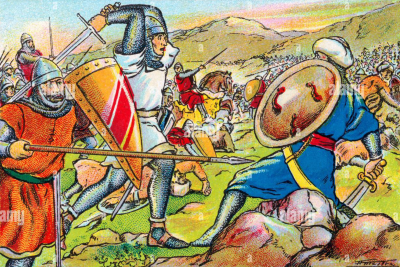
However, in his absence, the Roman city of Magnesia locked the gates, holding the Catalan treasures within. When Roger De Flor returned he was refused entry, and was enraged. When the Catalans besieged the city, Andronikos realized the situation was out of control and called Roger back to Constantinople. Roger ignored the order for months as he tried to force his way into Magnesia until winter set in.

The Catalans spent the winter of 1304 at Gallipoli, but suddenly were needed in Thrace when the Bulgarians invaded. Roger complied and sent some of his men to Constantinople under his deputy Berenguar, and even let him have the title of Grand Duke. But trouble arose because the co-emperor and son of Andronikos Michael IX, commanding the Roman army at Adrianople, hated them.
When the Catalans arrived Michael IX had defeated the Bulgarians on his own with the Roman army, and said they could leave. The Catalans “refused to go back to Asia before they had been paid for the plunder lost at Magnesia, and the Emperor was at his wits’ end to find the money.” Roger demanded 300,000 hyperpyra gold coins! I have seen people online who seem to believe the Catalans were revolting over a lack of pay, this is not the case. They were paid the fee agreed by Andronikos, which was twice the pay of other mercenaries – which made others jealous. The dispute was purely over the treasures hoarded by the Catalans as they sacked Roman cities in Anatolia.

Things got so heated that when Berenguar went to negotiate with Andronikos II a clear rift emerged. After a discussion with the Emperor, threw the ceremonial bonnet he had been given as Grand Duke into the sea as he sailed away. The Genoese were Roman allies who were distrustful of the Catalans. Thankfully for Andronikos they intervened and defeated some of the Catalan ships, capturing Berenguar. On the downside, there were now angry Catalans whom were stuck in Roman territory.

However, Roger De Flor had not rebelled as of yet, and Andronikos was desperate to keep it that way. “The Emperor tried to flatter Roger by giving him the title of Caesar. He paid him another installment and made a new contract with him in February 1305.” Roger agreed to return to Anatolia to continue the war against the Turks, but before going he expressed a desire to see Michael IX, with unknown motive.

During the tense meeting, an Alan mercenary, envious of higher Catalan pay, stabbed Roger De Flor in the back! It must have been a “Game of Thrones” moment. 300 Catalans who were with Roger were also massacred! “From that moment any semblance of control that the Emperor night have had over the Catalan Company vanished.” This was war, and there was no way going back now! Of course Michael IX was blamed, and thus be extension the Roman state as a whole. There is no evidence Andronikos desire this or wanted it.

Things spiraled out of control instantly. The Catalans “ran berserk over the whole coast of Thrace, pillaging, destroying, and slaughtering. They killed and enslaved all the inhabitants of the peninsula of Gallipoli.” The Catalans were ruthless, even killing women & children in many places. Gallipoli became a slave market for Romans! Even Turks were brought from Anatolia to join in the pillage and slaughter. For a moment of it must have seemed the Empire would fall!
Ultimately after ravaging Thrace fought their way through Greece the Catalans settled down at Athens. The successfully pursued a hostile takeover the Duchy of Athens, established after the Fourth Crusade by French Knights. Andronikos had made a huge mistake inviting them in, and the Roman Empire suffered greatly. But at least they ended up only as a marginal power in Greece instead of a major threat.
Source:
The Last Centuries of Byzantium (1261-1453) by Donald M. Nicol
“The Byzantine empire had to rebuild after its dismemberment by the Fourth Crusade in 1204. It recovered Constantinople in 1261 and this book narrates their empire’s struggles for survival from that date until its final conquest by the Ottomans.”
 shadowsofconstantinople.com