

“Touched by dawn, the gilded statue ‘blazed over the citizens like the sun.’”

The statue of Constantine was a glimmering statue in pagan style symbolizing the legacy of “the Romans, children of Aeneas and heirs of Augustus,” marking the birth of Constantinople, the greatest Roman city other than Rome itself!
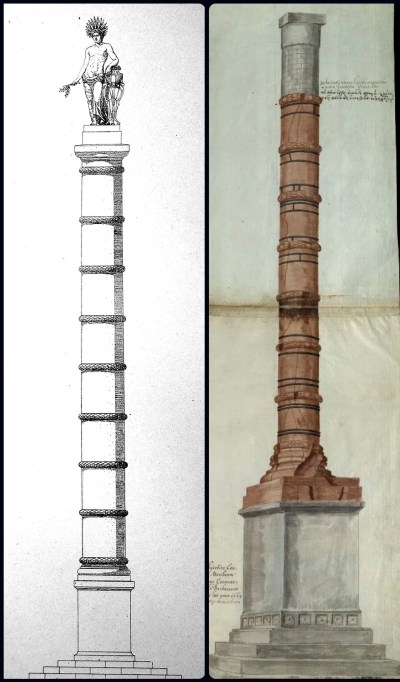
Reconstruction by Gurlitt (left) and an image from the Freshfield album, showing an old drawing of the Column of Constantine in Ottoman Constantinople.
There is no better introduction to the statue than the excerpt written by Anthony Kaldellis: “On May 11, 330, the sun rising behind the Asian hills across the Bosporos, shone for the last time on the ancient city of Byzantion. On that day, the emperor Constantine rededicated the city to himself and to the Fortune of Rome. Henceforth, Byzantion became Constantinople and, as New Rome, it would change the course of history. While the city below lay still in the predawn shadow, the sun reflected off its highest point, a colossal statue of Constantine himself. This was a golden bronze nude with rays emerging from his head, a spear in his left hand, and a globe signifying universal dominion in his right hand. Standing atop a column of purple stone that was almost forty meters tall and banded with victory laurel wreaths, the colossus was a repurposed Apollo.”

The statue displays Constantine’s complexity as a person: “It reinforced the emperor’s long association with the Solar God and the first emperor of Rome. Over three centuries before, Augustus had chosen Apollo to project the serene power, eternal youth, and classical order of his new golden age. Constantine’s statue also alluded to the colossus of Sol that stood beside the Coliseum in Rome and gave it its name, and it linked New Rome to nearby Troy, the ancient Roman homeland whose patron deity was Apollo. Constantine and his city thus picked up the thread of an old history: the Romans, children of Aeneas and heirs of Augustus…”

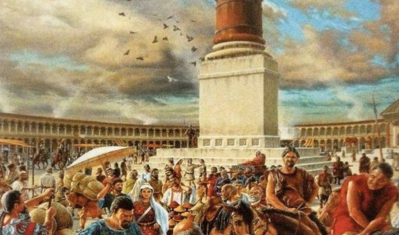
The column and the statue atop it stood in “the forum of Constantine…a circular paved plaza. The forum was enclosed by a two tiered colonnade of white marble.”
And there it remained until the reign of Alexios Komnenos when “in 1106, a gale finally toppled the colossal statue of Constantine-Apollo from the porphyry column in forum, the City’s symbolic focal point. That monument, which had survived fires and lightning, was a relic from a wildly different era.” It would later be replaced during the reign of Manuel Komnenos with a cross on top.

The founding of Constantinople by Constantine the Great in 330AD was celebrated annually by the people of the city on May 11. This mainly took place in the Forum of Constantine, where the column of Constantine is – and still exists today. What a cool holiday it must have been!
The Column of Constantine still exists today, even though it has lost of much its grandeur over time. That is only natural due to the ravages of time and less artistically-driven Ottoman restorations. It’s not how Constantine would picture it but cool it’s still there!
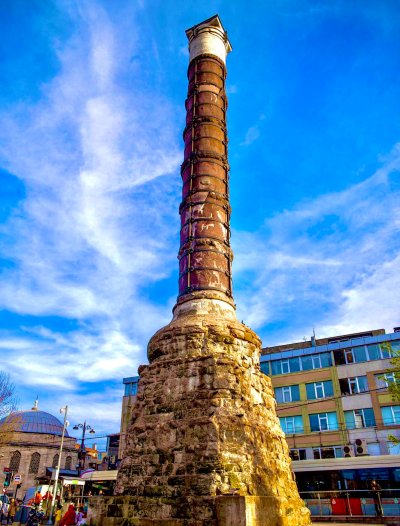
It’s pretty remarkable that the Column of Constantine, once in the center of the Forum of Constantine, still stands. Time has taken its toll on it, it’s not as majestic as it once was, the statue is gone. But, considering it was dedicated on May 11, 330AD – it’s holding up great! It is known in Istanbul as Çemberlitaş Sütunu (something like the burnt column).
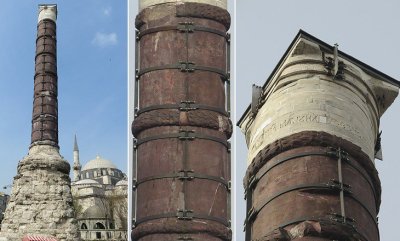
Was it the Greatest column in the city? It arguably could be. But the 10th century writer Constantine of Rhodes wrote that Justinian’s column “held first rank among the wonders which had been set fast in place on the heights of the city.”
SOURCES:
The New Roman Empire: A History of Byzantium by Anthony Kaldellis
 shadowsofconstantinople.com