

The battle of Manzikert in 1071, an infamous Roman defeat with profound long-term implications, is naturally the most well-known battle of Manzikert. However, in 1054 there was an interesting battle recorded by John Skylitzes. This article is basically just the story as Skylitzes tells it to us!
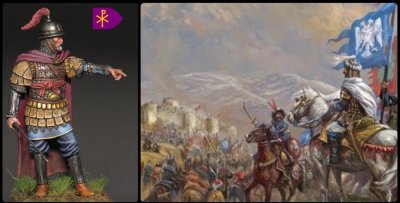
In 1054 the Seljuk Sultan mobilized his formidable army and marched against Romans. The Turks planned to conquer Manzikert. But the brave Roman defenders and their valiant commander Basil Apokapes had other ideas! The Seljuks, at odds with the Romans, had “combined all the Persian and Babylonian forces and invaded the Roman Empire.” They found many cities were garrisoned with walls, the Turks ultimately decided upon “trying the strength of Manzikert.”

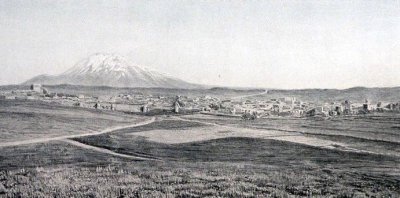
John Skylitzes described the city: “Manzikert is a city lying on a plain but it is surrounded by a triple wall and has a plentiful supply of spring water. At that time it was very well supplied with the necessities of life.” (Below is an old picture of the city in the Ottoman era to get an idea)
“The Sultan thought he could easily take it by siege since it was located in a position which gave advantage to the attacker; so he set up a palisaded camp as close as possible and laid siege to it.”
Thus the battle began!
The Sultan “spent thirty days relentlessly storming it, using various engines and every kind of machine. But the people inside courageously repelled the onslaughts, thanks to the experience and wisdom of the commander, the patrician Basil Apokapes.”
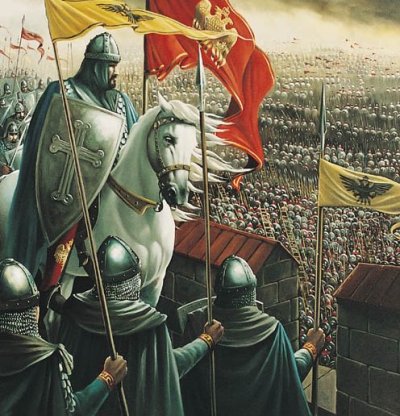
Things were not going well for the Seljuks, making no headway against the stout Roman defenses. “When it became clear to the Sultan that he was attempting the impossible, he decided to raise the siege and go back home. But the general of the Khorasians, Alkan, delayed this decision by asking for one more day and that [command] be turned over to him.”

“The Sultan was pleased with this and did postpone the retreat. Early next morning Alkan assembled the entire host under his command. He stationed the Sultan and such Turks as were of distinction where they could be seen, on an eminence facing the eastern gate of the city.”

Then Alkan “took the siege engines and came to the gate in question, for there the city walls seemed to be neither so high nor as strong. And as there was rising ground there, this was an advantage for the besiegers, permitting those outside the walls to fire on those within.”
Skylitzes says that Alkan “divided his forces…One half he stationed on the rising ground with orders to make exclusive use of the bow. As for himself, he had constructed tents of wickerwork covered over with ox hides and equipped with wheels under the supporting substructure…”
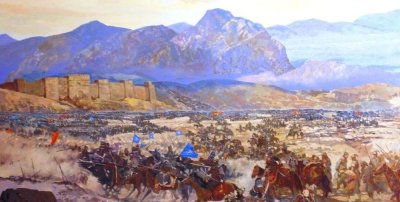
The goal was to move “up to the walls; then they could excavate the foundations without danger and at their leisure. He was counting on nobody being able to look down from the walls because of the heavy discharge of arrows.” But the commander Basil Apokapes was ready!
“This was the way in which he imagined he was going to take the city; but Apokapes, observing all this from the walls, commanded the sentries on the walls not to move a muscle and certainly not to lean out.” It was like movie scene, it made me think of Lord of the Rings when Faramir and the men of Gondor waited for the Orcs to cross the river at Osgiliath (No, I am not saying the Turks were Orcs…).
Basil Apokapes had a clear plan to deal with the Turks. The garrison was told to gather “hand-sized stones, arrows and other projectiles and wait until he gave the agreed signal (‘Christ help us!’). Once that was given, they could spring into action. He had by him some large beams, sharpened at one end. Those were his orders.”
“As for Alkan, while the Turks outside the city were shooting their arrows like hail and were (supposedly) striking down the people within the walls, he advanced the lesai little by little and so approached the wall.” I can only imagine how hard it was for the defenders to stay in cover as arrows rained down, praying one would not strike them down.
When Alkan and his men had almost got to the wall Apokapes suddenly gave the signal “Christ help us!” The men on the walls sprang into action and threw the heavy sharpened beams down on the tortoise shields of the Seljuks, breaking and puncturing them, while the rest fired arrows and stones.
Basil’s plan worked perfectly! “The tent (tortoise) which contained Alkan was overturned by the weight of the several beams which had pierced its roof. As it turned over, the men within were exposed to arrows and stones from all directions and against which nothing could offer any protection.”
“All the other men fell right there but Alkan was taken alive; he was recognisable by the splendour of his arms. Two handsome and excellent young men leapt out of the gates, seized him by the hair and dragged him into the city.” Brave and bold defending! This kind of martial spirit is often not stereotypically attributed to the medieval Romans, but they had true warriors among them as well.
Alkan was brought to him and “Basil instantly cut off his head and hurled it at the Turks. The Sultan was deeply distressed by this reverse; he raised the siege and departed, pretending that some compelling necessity obliged him to return home…”
SOURCE:
John Skylitzes: A Synopsis of Byzantine History, 811–1057: Translation and Notes
 shadowsofconstantinople.com